A growing population. Favorable household incomes. Strong traffic counts. A well-located building with competitive lease terms.
On paper, the fundamentals appear compelling.
For decades, these have been among the primary considerations used to evaluate potential locations for medical practices and healthcare facilities. And for good reason: demographic characteristics, accessibility, and real estate economics can significantly influence a location's suitability.
But healthcare real estate is not conventional commercial real estate.
A location can have excellent demographics and still be poorly positioned for a particular medical specialty. A seemingly underserved market may present substantial operational challenges. A property offering attractive lease economics may require extensive improvements before it can accommodate a healthcare use.
The question, therefore, is not simply whether a location looks attractive.
It's whether that location is the right fit for the specific healthcare organization, its patients, its operations, and its long-term objectives.
Answering that question requires a more comprehensive approach to site selection.
Demographics Are the Starting Point, Not the Conclusion
Population characteristics provide essential context for healthcare real estate decisions.
Age distribution, household income, population growth, employment, and insurance coverage can help organizations understand the communities they intend to serve.
The U.S. Census Bureau's American Community Survey, for example, provides a broad range of demographic, economic, housing, and commuting information that can inform geographic analysis.
But demographic indicators become considerably more useful when interpreted in relation to the services a healthcare organization actually provides.
A growing community of young families may present different opportunities from an established neighborhood with an aging population. A market with attractive household incomes may not necessarily offer the patient characteristics, accessibility, or referral relationships required by a particular specialty.
Even within the same metropolitan area, two locations with similar demographic profiles can have meaningfully different healthcare market characteristics.
This is where traditional demographic screening begins to show its limitations.
Demographics help explain who lives in a market. They do not, by themselves, explain how healthcare is delivered within it.
For that, decision-makers must examine the surrounding healthcare ecosystem.
Understanding the Healthcare Ecosystem
Healthcare markets are networks of providers, facilities, specialties, patients, and referral relationships.
Evaluating a potential medical office location requires an understanding of that network.
Consider two candidate properties serving communities with similar population characteristics.
The first is located near an established concentration of physicians, outpatient facilities, and complementary medical specialties. The second is situated in a rapidly developing area with relatively few existing healthcare providers.
Which represents the stronger opportunity?
There is no universally correct answer.
For a specialty practice that relies heavily on physician referrals, proximity to complementary providers may be a meaningful strategic advantage.
For a primary care organization seeking to establish a presence in a growing community, a market with limited existing service capacity may warrant further investigation.
For an organization expanding an established regional footprint, either location may need to be evaluated in relation to its existing facilities, patient distribution, and service-area strategy.
The presence of other healthcare providers also requires careful interpretation.
Competing practices may indicate that a market supports significant healthcare activity. They may also indicate a highly contested patient environment.
Similarly, relatively few providers do not automatically establish unmet demand.
An apparent shortage may reflect accessibility challenges, workforce constraints, reimbursement conditions, population characteristics, or other factors that affect the feasibility of operating in that market.
Federal Health Professional Shortage Area designations can provide additional context for certain primary care, dental, and mental health markets. However, these designations are specific to defined geographic areas, populations, or facilities and should not be treated as universal indicators of opportunity for every medical specialty.
Provider information is also subject to important limitations.
The Centers for Medicare & Medicaid Services maintains the NPI Registry, which includes public information such as provider classifications and practice addresses. CMS cautions that possession of an NPI does not independently validate a provider's licensure or credentials.
Provider records are therefore useful analytical inputs, but they are not substitutes for verifying current operations, service availability, practice capacity, or actual referral relationships.
The essential principle is straightforward:
Healthcare provider data becomes valuable when it is interpreted within the context of a specific clinical and business strategy.
Accessibility Is More Than a Point on a Map
A property's physical location is another critical consideration.
But geographic proximity and practical accessibility are not necessarily the same thing.
Two properties may be located a similar distance from a target patient population while offering very different patient experiences.
One may benefit from convenient highway access, intuitive entrances, ample parking, and a straightforward route from nearby residential communities.
The other may sit across a difficult intersection, have limited parking, or require patients to navigate a confusing office complex.
These differences can matter, particularly for practices serving patients with mobility limitations, older populations, or those who require frequent follow-up visits.
Accessibility should therefore be evaluated across multiple dimensions:
- Travel patterns and practical drive times.
- Roadway access and surrounding transportation infrastructure.
- Parking availability and patient convenience.
- Building entrances and physical accessibility.
- Proximity to complementary medical services.
- Visibility and ease of locating the practice.
A strategically positioned healthcare facility should be accessible not only geographically, but operationally.
An attractive location on a demographic map may look considerably different when evaluated from the patient's perspective.
Workforce Availability Can Determine Whether Expansion Is Feasible
A successful healthcare expansion requires more than a suitable building and an attractive patient market.
It also requires people.
Physicians, nurses, medical assistants, technologists, administrative professionals, and other specialized personnel are essential to healthcare operations.
Their availability can vary substantially between markets.
For certain specialties, staffing considerations may be especially significant. A location may offer compelling patient-market characteristics but present meaningful recruitment challenges for the clinical personnel necessary to operate the facility.
Labor costs and workforce competition can further affect the economics of expansion.
The Bureau of Labor Statistics publishes metropolitan and nonmetropolitan occupational employment and wage estimates, which can provide useful regional workforce context.
Such information does not establish how many qualified professionals are available for immediate hiring at an individual location. It does, however, illustrate why labor-market analysis belongs alongside demographic and property analysis.
For multi-location healthcare organizations, a more comprehensive site selection process should consider whether the organization can realistically staff and sustain the operation it intends to establish.
An otherwise attractive location may lose much of its appeal if the underlying staffing model is difficult to execute.
The Lowest Real Estate Cost Is Not Always the Best Financial Decision
Real estate economics are essential to every location decision.
But comparing asking rents alone provides an incomplete picture.
Healthcare facilities often have specialized infrastructure requirements that differ substantially from those of conventional office or retail users.
Depending on the clinical use, these may include specialized plumbing, electrical capacity, HVAC requirements, imaging infrastructure, clinical circulation, accessibility improvements, and other building modifications.
As a result, the total cost of occupying a property can differ significantly from what its advertised rental rate suggests.
A second-generation medical office space with an appropriate existing layout may offer considerable advantages over a lower-rent property requiring extensive improvements.
Conversely, paying a premium for an existing medical facility may not be justified if the space requires substantial reconfiguration to accommodate a different specialty.
A comprehensive evaluation should consider:
- Base rent and anticipated occupancy expenses.
- Tenant improvement requirements.
- Existing clinical infrastructure and suitability.
- Construction costs and delivery timelines.
- Landlord concessions and improvement allowances.
- Lease flexibility and expansion potential.
- Operational disruption and execution risk.
The relevant question is not simply, "Which building offers the lowest rent?"
It is, "Which location provides the strongest combination of strategic suitability, operational feasibility, and total economic value?"
Those are very different questions.
Different Healthcare Organizations Need Different Evaluation Criteria
One of the greatest limitations of traditional site selection is the assumption that every property can be evaluated using the same fixed criteria.
Healthcare organizations are not interchangeable.
An urgent care operator may prioritize highly convenient access, visibility, parking, and consumer-oriented trade-area characteristics.
A surgical specialty practice may place greater emphasis on proximity to referring physicians, suitable existing infrastructure, and compatibility with the organization's clinical operations.
An outpatient therapy provider may evaluate patient accessibility, the availability of appropriate space, and the economics of frequent recurring visits.
A large healthcare system may also consider network coverage, market overlap, existing investments, organizational strategy, and long-term portfolio objectives.
Even within the same medical specialty, priorities can differ based on the organization's business model and growth strategy.
This is why a structured evaluation framework should allow decision-makers to define and prioritize the factors that matter most to a particular assignment.
A More Comprehensive Evaluation Framework
A disciplined healthcare site selection process can be organized around six connected dimensions.
1. Population and Market Characteristics
Understand the demographic composition, growth patterns, and socioeconomic characteristics of the communities surrounding each location.
2. Healthcare Provider Environment
Evaluate the distribution of relevant specialties, competing providers, complementary services, and the surrounding healthcare ecosystem.
3. Accessibility and Geographic Position
Consider practical travel patterns, patient convenience, transportation infrastructure, building access, and the relationship between the location and its intended service area.
4. Workforce and Operational Considerations
Assess whether local labor-market conditions, staffing requirements, and operational constraints support the intended use.
5. Property Suitability and Financial Fit
Examine the physical characteristics, infrastructure, occupancy costs, improvement requirements, and economic implications of each candidate.
6. Strategic Alignment
Determine how each location supports the organization's broader objectives, existing portfolio, expansion priorities, and tolerance for execution risk.
These dimensions are interconnected.
A strong demographic market cannot compensate automatically for an unsuitable building. A financially attractive lease does not eliminate workforce constraints. A strategically desirable property may still present unacceptable operational risk.
The objective is not to identify one universally perfect location. It is to identify the strongest location for a clearly defined set of organizational priorities.
From Property Comparison to Defensible Decisions
Consider a hypothetical healthcare organization evaluating two potential locations.
Property A offers a lower rental rate, favorable population growth, and strong visibility along a major roadway.
Property B has a higher rental rate but includes an existing medical layout, easier access for the intended patient population, and proximity to several complementary healthcare providers.
A traditional survey may present both locations side by side, listing their respective rents, square footage, demographics, photographs, and building features.
That information is valuable.
But the survey alone does not establish how the organization should evaluate the trade-offs.
If minimizing initial occupancy expenses is the overriding priority, Property A may warrant greater consideration.
If speed to occupancy, clinical suitability, and strategic positioning carry greater weight, Property B may emerge as the stronger candidate.
The conclusion depends on the organization's priorities.
A structured evaluation process makes those priorities explicit.
It allows the organization to establish consistent criteria, apply appropriate relative weights, compare candidates systematically, and understand why one location may be preferable to another.
It also makes the analysis easier to revisit when assumptions change.
If construction costs increase, a prospective referral relationship changes, or a different lease term becomes available, the original decision can be reevaluated without starting the entire process over.
This is particularly valuable for healthcare organizations managing multiple locations or pursuing expansion across several markets.
Building Institutional Knowledge Through Better Site Selection
Healthcare real estate decisions are rarely isolated events.
Organizations expand, relocate, renew leases, consolidate operations, and evaluate new markets over time.
Yet the information developed during previous site searches is often scattered across spreadsheets, presentation decks, email threads, broker surveys, and archived files.
When that information is difficult to retrieve, each new assignment may begin with much of the same work.
A more disciplined approach preserves not just the properties that were considered, but also the criteria used to evaluate them, the assumptions behind the analysis, and the reasoning that informed the final decision.
This creates an increasingly valuable institutional record.
Future teams can understand why a particular location was selected, what alternatives were considered, and how the organization's priorities have evolved.
For growing healthcare organizations, that continuity can improve both the consistency and transparency of the real estate decision-making process.
Better Technology Should Support Better Judgment
Technology can make healthcare site selection more consistent, collaborative, and analytically useful.
Interactive mapping, healthcare market intelligence, structured property comparisons, and customizable evaluation frameworks can bring previously disconnected information into a unified workflow.
But technology should not replace professional judgment.
No single dataset, numerical score, or automated recommendation can capture every relevant consideration in a healthcare real estate decision.
A strong decision-support platform should make the underlying evidence easier to examine, the trade-offs easier to understand, and the organization's priorities easier to apply.
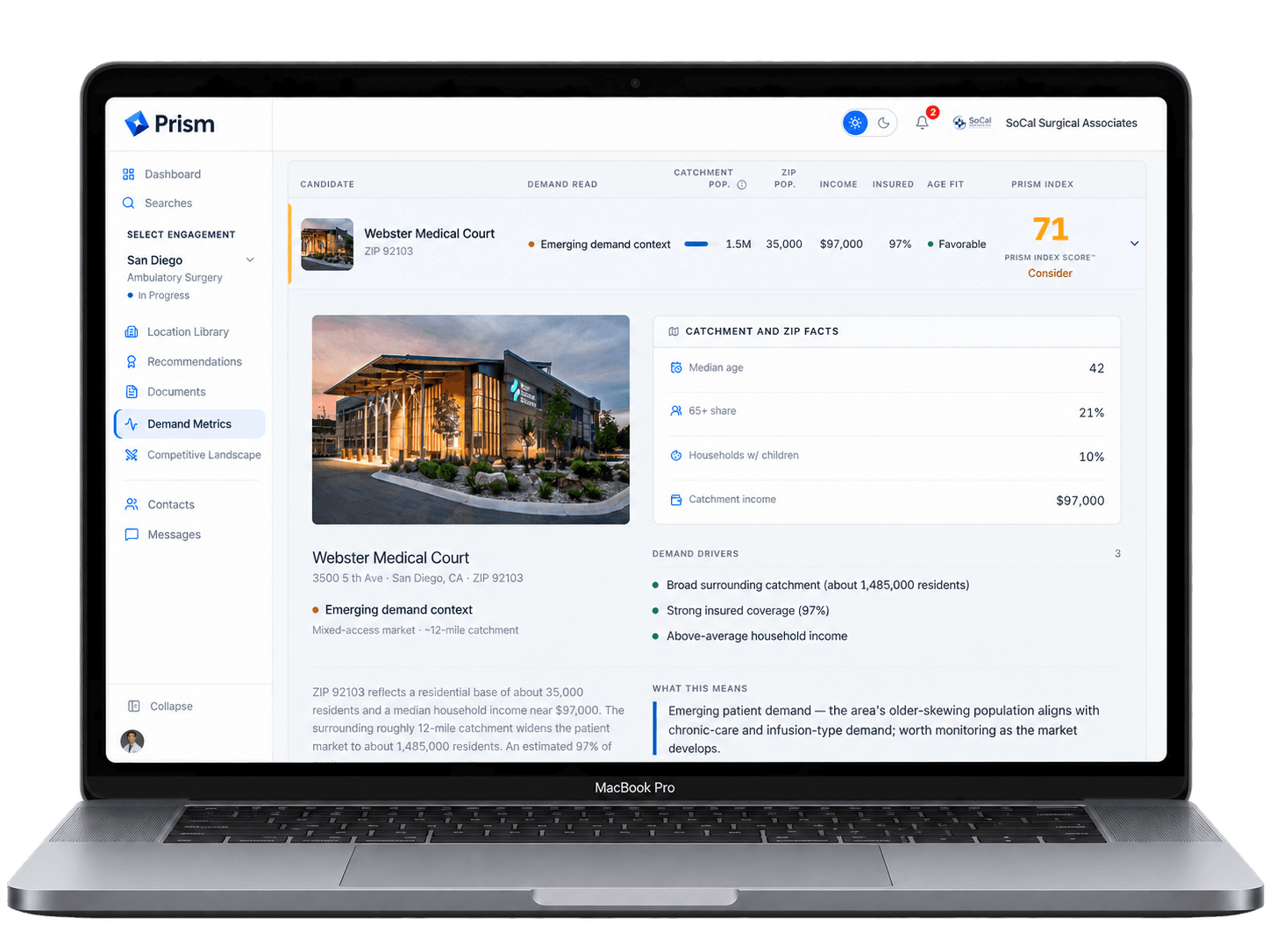
That philosophy informs the development of Prism, a healthcare real estate decision-intelligence platform designed for commercial real estate advisors and healthcare organizations.
By bringing broker surveys, healthcare market information, property comparisons, collaborative workflows, and the customizable Prism Index Score™ into one environment, Prism helps teams approach location decisions with greater structure and clarity.
The goal is not to remove people from the decision-making process.
It is to give them better information and a more disciplined way to use it.
The Future of Healthcare Site Selection
Demographics will always be a fundamental component of healthcare site selection.
But population growth, household income, and market visibility are only parts of a much larger equation.
The strongest location decisions consider how patients access care, how providers interact within a market, whether operations can be supported, and how the economics of a property align with the organization's long-term objectives.
They also establish a consistent basis for comparing alternatives and explaining the final recommendation.
For healthcare organizations and their real estate advisors, this represents a meaningful shift in perspective.
The objective is no longer simply to identify available properties in attractive markets.
It is to evaluate each opportunity within a comprehensive framework that connects market intelligence, operational realities, real estate economics, and organizational strategy.
Because the best healthcare real estate decision is not necessarily the one with the strongest demographics or the lowest asking rent.
It is the one supported by the strongest overall reasoning.
Explore how Prism supports more informed healthcare real estate decisions.
Discover Prism's Healthcare Intelligence Platform
Sources and Further Reading
The following public resources provide background on several concepts discussed in this article. They are informational references, not a disclosure of Prism's underlying data sources.