For decades, the broker survey has been a fundamental part of commercial real estate advisory.
Whether a client is evaluating three medical office buildings or planning a multi-market expansion, the process typically begins the same way: identify available properties, compile the relevant information, organize the alternatives, and present the findings.
The finished product often takes the form of a PDF, PowerPoint presentation, or spreadsheet.
Property photographs. Square footage. Asking rents. Location maps. Building descriptions. Lease terms.
All essential information.
But the traditional broker survey has a fundamental limitation: it is designed primarily to present information, not to manage the decision-making process that follows.
Once delivered, the survey often becomes outdated almost immediately.
New properties emerge. Availability changes. Lease economics are revised. Clients request additional information. Previously rejected options return to consideration.
The broker updates the presentation, distributes another version, and the cycle begins again.
At Prism, we believe the broker survey should be something more.
It should be a living, intelligent workspace that evolves with the assignment, connects market intelligence to property evaluation, and helps clients make more informed decisions.
The Problem With Static Broker Surveys
Traditional broker surveys serve an important purpose. They organize complex real estate information into a format that clients can understand.
But they also create several challenges.
Information becomes fragmented.
Property details may originate in listing reports, broker correspondence, spreadsheets, photographs, mapping applications, and market research tools.
Assembling that information into a client-ready presentation can require substantial manual effort.
The presentation quickly becomes outdated.
When property availability or financial terms change, the original survey no longer reflects the latest information.
The broker must revise the document and redistribute it, often creating multiple versions of the same assignment.
Comparisons are difficult to standardize.
A building's asking rent may be presented prominently, while improvement requirements, healthcare infrastructure, access characteristics, and strategic considerations receive less consistent treatment.
The decision history is easily lost.
Months after an assignment concludes, it may be difficult to reconstruct why one property was preferred over another.
The final presentation captures the outcome, but not always the reasoning.
These limitations become increasingly significant as assignments grow in complexity.
For healthcare real estate in particular, the number of relevant considerations can extend well beyond the conventional property facts found in a listing report.
Introducing Prism Broker Surveys
Prism approaches the broker survey as an ongoing decision-making process rather than a finished document.
Instead of assembling disconnected property information into a static presentation, brokers can organize their searches within a single platform.
Candidate properties, photographs, location information, financial characteristics, and relevant healthcare market context are brought together in a structured environment.
As an assignment progresses, brokers can refine the candidate set, compare alternatives, and preserve the information associated with each location.
The objective is straightforward:
Less time assembling information. More time evaluating opportunities and advising clients.
Prism does not eliminate the value of traditional brokerage expertise.
It gives that expertise a more effective platform.
Every Property, in Context
A medical office building cannot be evaluated solely by its asking rent and available square footage.
Its suitability depends on the intended use, the surrounding market, the organization's operating requirements, and the financial implications of occupancy.
Prism helps brokers evaluate those considerations together.
A property record can be understood within the context of the broader search rather than as an isolated listing.
Property attributes and economics are connected to geographic positioning and healthcare market characteristics, creating a more useful foundation for comparison.
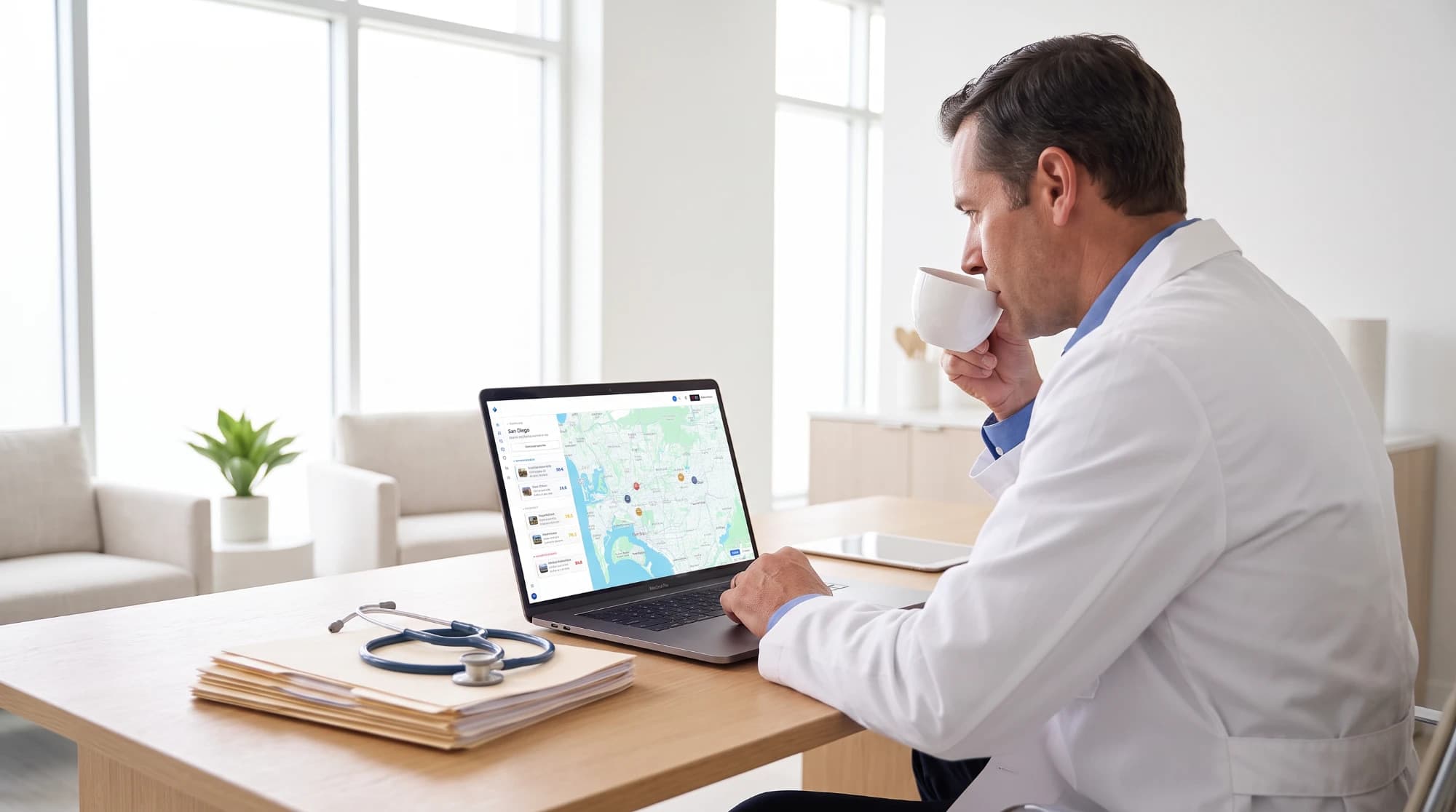
Interactive mapping allows users to visualize candidate locations geographically, while organized property information supports a consistent review of the alternatives.
For healthcare assignments, this broader perspective is especially important.
A building may offer attractive lease terms but sit outside the organization's preferred service area.
Another may have superior geographic positioning but require significant improvements.
A third may provide the best operational fit despite a higher occupancy cost.
None of those conclusions is evident from asking rent alone.
The real value of a broker survey lies in helping clients understand those trade-offs.
From Information to Evaluation
Traditional surveys are excellent at answering one question:
What properties are available for consideration?
But sophisticated real estate decisions require answers to additional questions.
Which properties align most closely with the client's priorities?
What makes one alternative strategically stronger than another?
How should financial considerations be weighed against location suitability?
And how can the broker communicate those differences consistently?
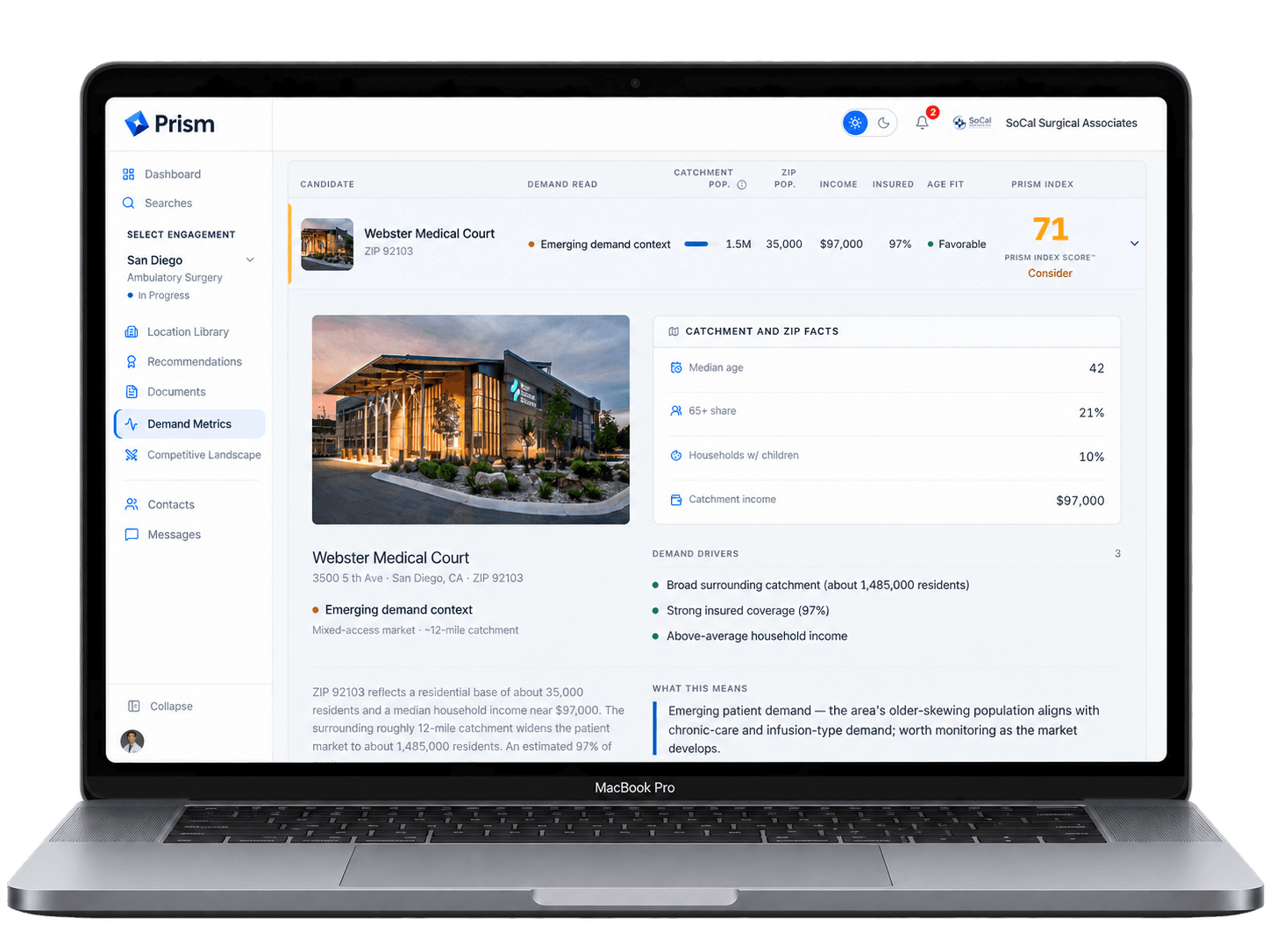
Prism addresses this through structured property evaluation and the proprietary Prism Index Score™.
The Prism Index Score provides a framework for comparing candidate properties using defined evaluation criteria.
Rather than relying entirely on subjective impressions or inconsistent property narratives, users can establish relative priorities and evaluate locations against a common set of considerations.
Those priorities can be customized to reflect the assignment.
A healthcare organization focused on minimizing occupancy expenses may evaluate properties differently from one prioritizing geographic coverage, existing clinical infrastructure, or long-term strategic positioning.
The scoring framework makes these distinctions more explicit.
Importantly, the score is not intended to replace professional judgment.
It supports judgment by organizing the relevant considerations, applying the selected criteria consistently, and making the comparison easier to understand.
The strongest recommendation is not simply the property with the highest numerical score. It is the property whose advantages and trade-offs can be clearly explained in relation to the client's objectives.
A Better Experience for the Client
The broker survey is ultimately a communication tool.
Its purpose is to help a client evaluate alternatives and reach a decision with confidence.
Yet conventional presentations often require clients to navigate lengthy documents, compare information across multiple pages, and refer back to email conversations for clarification.
Prism offers a more connected experience.
Through its client-facing portal, brokers can present relevant property and search information in an organized digital environment.
Clients can review candidate locations and their associated information without depending entirely on a series of static presentations.
The broker retains an important role in managing the assignment, preparing the information, and guiding the evaluation.
The result is a more coherent relationship between the broker's working process and the client's decision-making experience.
For multi-location healthcare organizations, the benefits of that structure can extend across multiple assignments.
Different stakeholders may need to understand different aspects of a location decision, from strategic suitability to financial implications.
A consistent presentation framework makes those discussions easier to manage.
Designed for the Way Healthcare Real Estate Actually Works
Healthcare real estate assignments present requirements that conventional commercial property surveys do not always address effectively.
A medical office tenant may need to evaluate existing clinical layouts, accessibility, patient parking, proximity to complementary providers, specialty-specific infrastructure, and anticipated improvement costs.
A multi-site healthcare organization may need to evaluate location alternatives within a broader network strategy.
An outpatient operator expanding across several markets may need to compare opportunities using consistent criteria while recognizing the differences between individual communities.
These considerations do not exist independently.
They influence one another.
A strategically attractive market may have limited suitable real estate.
A building with favorable occupancy economics may offer inadequate clinical infrastructure.
A location near complementary medical specialties may command higher rent but offer other strategic advantages.
Prism is designed to bring these considerations into the same decision-making environment.
The platform combines property information, healthcare market intelligence, customizable evaluation criteria, and collaborative workflows to support a more comprehensive analysis.
That does not mean every healthcare assignment should produce the same answer.
It means every assignment can benefit from a more consistent, transparent evaluation process.
A Living Record of the Search
One of the most valuable aspects of a modern broker survey is what happens after the initial presentation.
As properties are reviewed, the search develops its own history.
Alternatives are added or removed. Financial assumptions change. Certain locations advance while others fall out of consideration.
Eventually, a recommendation is made and the assignment moves toward completion.
In a traditional workflow, much of that decision history may be distributed across disconnected documents and communications.
Prism is designed to preserve the work within the search itself.
Completed evaluations become part of a reusable record rather than disappearing into an archive of outdated presentations.
That continuity creates value beyond a single transaction.
For brokers, it provides a more organized history of previous assignments and recommendations.
For healthcare organizations, it supports consistency when evaluating future locations, revisiting earlier decisions, or planning additional expansion.
Over time, these records can become a valuable source of institutional knowledge.
Better Technology, Stronger Advisory Relationships
Technology is often discussed in terms of automation and efficiency.
Those benefits matter.
But the greatest opportunity in modernizing the broker survey is not simply reducing the time required to create a presentation.
It is improving the quality of the advisory process.
When information is organized, comparisons are consistent, and decision criteria are clearly understood, brokers can devote more attention to the work that creates lasting value.
Understanding the client's business.
Evaluating the trade-offs between alternatives.
Anticipating potential obstacles.
Negotiating favorable terms.
And helping decision-makers reach a well-supported conclusion.
Prism is built around that philosophy.
The platform does not replace the broker-client relationship.
It helps make that relationship more informed, more collaborative, and more effective.
The Next Generation of Broker Surveys
The broker survey is not going away.
It remains an essential part of how commercial real estate professionals communicate opportunities and recommendations.
But the tools used to create, maintain, and share those surveys should evolve.
Clients increasingly expect accessible information, consistent analysis, and greater transparency in the decision-making process.
Brokers need tools that help them manage complex assignments without constantly rebuilding the same deliverables.
And healthcare organizations need a way to connect individual property decisions to broader operational and strategic objectives.
Prism brings these needs together in a single healthcare real estate decision-intelligence platform.
The future of the broker survey is not another static report. It is a connected, collaborative decision-making experience.
One that makes the broker more effective, the client better informed, and every real estate decision easier to understand.
See Broker Surveys Differently
Discover how Prism combines property information, interactive mapping, healthcare market intelligence, and structured comparisons in one connected workspace.
Explore Prism Broker Surveys