For decades, healthcare real estate was largely understood through a familiar set of property types: hospitals, medical office buildings, and purpose-built clinical facilities.
Those properties remain essential to healthcare delivery.
But the way healthcare organizations choose real estate is changing.
Urgent care providers occupy retail storefronts. Physical therapy practices operate in shopping centers. Physician groups convert traditional office space into clinical environments. Health systems continue expanding outpatient facilities beyond their principal hospital campuses.
The underlying shift is significant.
Healthcare organizations are increasingly choosing locations based on where and how they need to deliver care—not simply whether a building was originally classified as medical office.
And the industry data supports that evolution.
The Traditional Medical Office Market Is Increasingly Constrained
Medical outpatient buildings remain an important and resilient real estate sector.
According to the 2026 Emerging Trends in Real Estate® report from PwC and the Urban Land Institute, medical outpatient building occupancy reached 92.7% across the top 100 U.S. metropolitan markets in the second quarter of 2025.
Strong demand, limited new construction, and rising development costs have tightened the availability of well-located medical space.
At the same time, healthcare organizations face pressure to expand outpatient access while managing occupancy costs and capital requirements.
Those forces are pushing providers to consider alternatives.
JLL's 2025 Medical Outpatient Building Perspective examined the property types selected by physician offices moving into new space during 2024 (page 8 of the report).
Its findings illustrate how much the market has diversified:
- 52% moved into medical outpatient buildings.
- 24% moved into nonmedical office properties.
- 8% moved into retail properties.
- 11% moved into other healthcare facilities.
- 5% moved into other property types.
In other words, almost half of the physician offices in JLL's analysis moved into something other than a traditional medical outpatient building.
This isn't merely a prediction about where healthcare might go.
It's evidence of where providers are already locating.
Healthcare Is Becoming a Neighborhood Business
Historically, many healthcare services were concentrated around major hospital campuses and established medical districts.
Today, convenience and accessibility are increasingly important to outpatient location strategies.
For recurring and lower-acuity services, being close to where patients live, work, and conduct their everyday activities can offer meaningful advantages.
Consider the range of healthcare uses now appearing in conventional commercial settings.
Retail properties
Physical therapy, dentistry, optometry, certain primary care and urgent care concepts, and other suitable outpatient practices can benefit from visible, accessible neighborhood locations.
Traditional office buildings
Physician practices, behavioral health providers, healthcare administrative users, and certain outpatient specialties may find suitable space in conventional office properties, subject to conversion economics and facility requirements.
Mixed-use and adaptive-reuse properties
Existing commercial real estate can create opportunities to bring healthcare services closer to established residential and employment centers.
Flex and industrial properties
Some healthcare-support operations, including distribution, logistics, and specialized non-patient-facing functions, may require environments outside traditional medical office real estate.
Their operational needs are different from those of a patient-facing clinical practice and should be evaluated accordingly.
The common thread is not the original building classification.
It's the relationship between the intended healthcare use, the surrounding market, and the physical property.
Adaptive Reuse Is Becoming Part of the Healthcare Strategy
New construction is not always the most practical way to satisfy growing healthcare demand.
In its 2026 midyear healthcare outlook, CBRE reported that 43% of current medical outpatient building conversions are from retail properties and 42% are from traditional office buildings.
CBRE also projects that conversions will account for a record 5.5% of all healthcare construction in 2026.
Those figures highlight an important shift in how providers and developers approach real estate supply.
An existing property with the right access, location, economics, and conversion potential may deserve consideration even if it was never originally designed as a healthcare facility.
But that does not make every vacant office building or retail storefront a viable medical location.
The Building Still Has to Work
A healthcare tenant brings requirements that can differ dramatically from conventional office or retail occupancy.
Depending on the clinical use, those considerations may include parking demand, accessibility, plumbing, electrical capacity, HVAC systems, specialized equipment, patient circulation, permitting, and regulatory requirements.
A physical therapy practice and an ambulatory surgical center do not have interchangeable facility requirements.
A traditional office conversion might work exceptionally well for one and be prohibitively expensive or unsuitable for the other.
Healthcare real estate can also carry compliance considerations beyond building design.
As Lincoln Property Company noted in its February 2026 healthcare real estate analysis, certain hospital and physician-related lease arrangements can raise fair-market-value, commercial-reasonableness, and regulatory concerns, including under the Stark Law and the Anti-Kickback Statute.
Those issues require appropriate professional diligence.
The objective is not to disregard property types or technical requirements.
It's to avoid ruling out a potentially viable location merely because it doesn't carry a medical office designation.
Site Selection Should Start With the Healthcare Use Case
This broader property universe changes the questions brokers and healthcare organizations need to ask.
Instead of beginning exclusively with available medical office inventory, a more useful evaluation begins with the organization's operating requirements.
What patient population does the service need to reach?
Where is that population concentrated?
What competing or complementary healthcare providers already operate in the market?
How important are visibility, access, proximity to other facilities, and convenient parking?
What occupancy costs can the organization support?
Which physical requirements are nonnegotiable?
Only then should the team determine which buildings are plausible candidates.
This approach creates an opportunity to identify locations that a property-type-only search might overlook.
It also provides a more rigorous basis for rejecting properties that look attractive on paper but fail the organization's actual clinical or economic requirements.
How Prism Supports a Broader Healthcare Property Search
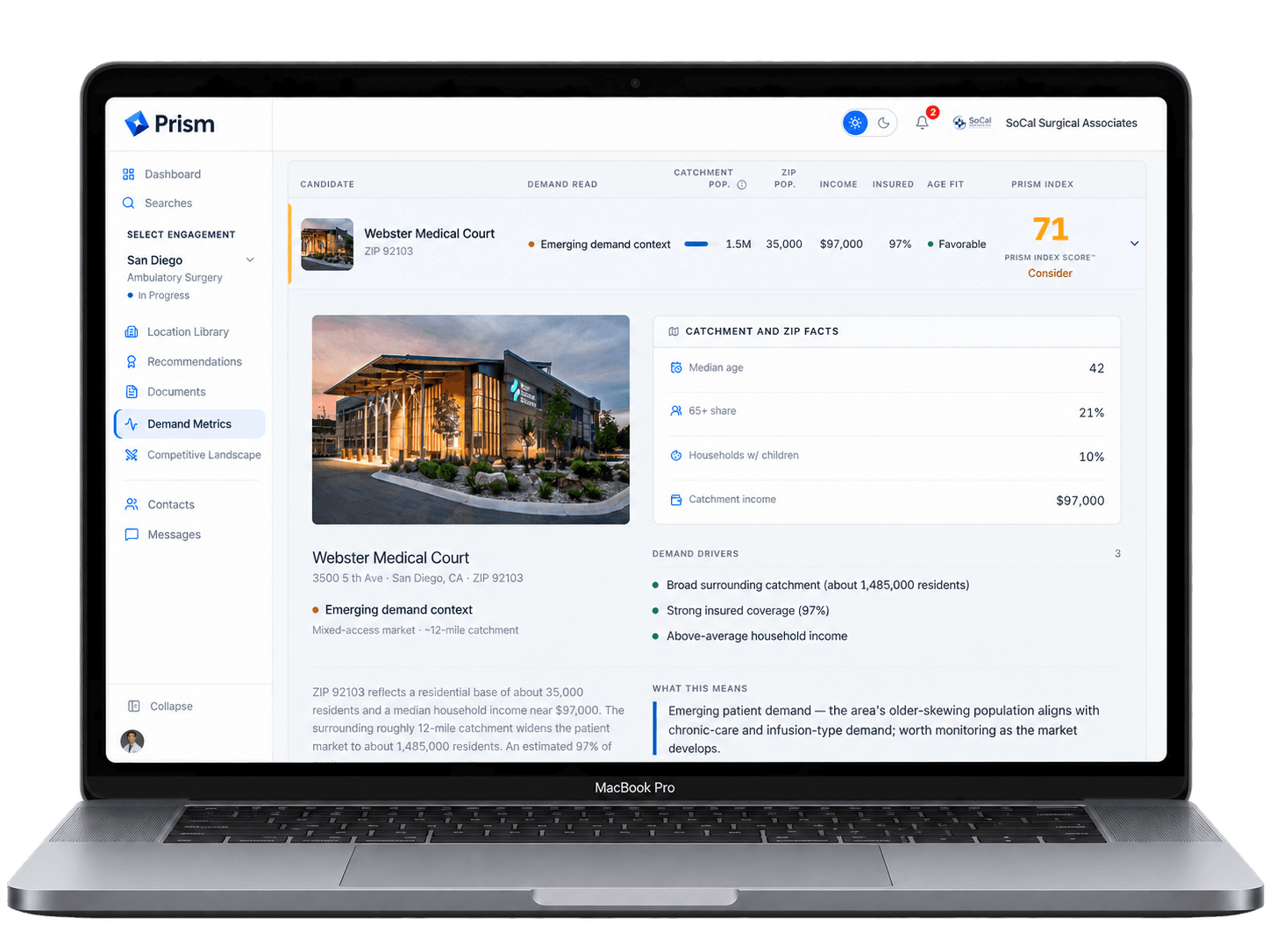
Prism was designed around healthcare real estate decisions rather than a single property classification.
The platform brings market indicators, competitive healthcare context, geographic considerations, property information, and financial assumptions into a structured evaluation framework.
That allows brokers and healthcare organizations to assess candidates across different property types against a consistent set of priorities tied to the intended healthcare use.
Its Prism Index Score™ combines Strategic Site Viability and Financial Fit so teams can compare the strengths and compromises of each candidate.
A well-located traditional office conversion can be evaluated alongside a purpose-built medical facility or an appropriately configured retail property.
Each candidate's property type is recorded and checked against the property types a search is considering, but the evaluation itself is driven by the healthcare use, the market, and the economics of the deal.
The comparison isn't based on whether one building looks more like a conventional medical office building.
It's based on how well each candidate meets the search's strategic and financial priorities.
Prism does not replace architectural, engineering, zoning, licensing, legal, or other specialized due diligence.
Those remain essential to confirming whether a property can actually accommodate a proposed healthcare operation.
But Prism can help teams determine which candidates deserve closer consideration and where to focus their time and resources.
A Broader Universe Demands a Better Evaluation Framework
Medical outpatient buildings aren't going away.
They will remain critical infrastructure for a healthcare system increasingly focused on outpatient delivery.
What is changing is the assumption that healthcare activity must be confined to them.
The most promising healthcare location may be a medical office building.
It may also be a converted traditional office property, a neighborhood retail center, or another appropriately configured commercial facility.
The industry is moving toward a more flexible approach to healthcare real estate.
The evaluation process should be just as flexible—without sacrificing discipline.
The future of healthcare site selection isn't about choosing between medical and nonmedical property types. It's about finding the right environment for the care being delivered.
Better site selection starts with a broader perspective.
Explore how Prism helps healthcare organizations evaluate real estate opportunities using market intelligence and financial fit.
Explore the Prism Platform Learn about the Prism Index Score™
Research and Further Reading
The research cited in this article, summarized in our own words. Each source is an independent publication; none is a Prism data source.
- PwC and the Urban Land Institute — Emerging Trends in Real Estate® 2026: Medical Office. Medical outpatient occupancy across the top 100 U.S. metro areas, rents, construction and transaction activity, as of the second quarter of 2025.
- JLL — 2025 Medical Outpatient Building Perspective (March 2025, PDF). Outpatient trends, including the property types chosen by physician offices moving into new space in 2024 (page 8).
- CBRE — U.S. Real Estate Market Outlook Midyear Review 2026: Healthcare. Healthcare real estate supply and demand, including the conversion of retail and office properties into medical outpatient space.
- Lincoln Property Company — Healthcare Real Estate Strategy in 2026 (February 10, 2026). Hospital growth, outpatient demand and the compliance considerations in healthcare leasing.
- JLL — Medtail in Transition (April 2025). How healthcare uses are occupying, and changing, retail real estate.